
Estate Planning In Leawood, Kansas
Protect your family’s future with a comprehensive estate plan tailored to your unique needs.
55% of Americans have no estate planning documents at all, while only 31% have a will and just 11% have a trust (Trust & Will 2025 Estate Planning Report (WeAreTalker/OnePoll, 10,000 respondents)).
Estate planning is not just for the wealthy. If you own a home, have children, run a business, or have savings you want to keep safe, you need a plan in place.
Without these legal protections, Kansas law decides who receives your property, who raises your children, and who makes medical decisions for you if you’re unable to do so yourself.
A clear, well-written plan gives you control over your future. It helps your family avoid confusing legal hurdles and ensures your wishes are actually followed. At The Eastman Law Firm, we focus on helping families across Johnson and Wyandotte Counties create plans that provide real security and simple, honest answers.
Since 1998, attorney Gary Eastman has used his 27 years of experience to create 5,423 trusts and 1,257 wills for 5,407 clients. This includes helping 1,134 families in Johnson County and many more in Wyandotte County protect what they have worked hard to build.

Gary brings a unique background to every client, combining 27 years of local experience with the high-level training he received at Polsinelli, a top 100 national law firm. There, he managed over 500 complex business transactions, and he now uses that same attention to detail to help families throughout the Kansas City area.
Our goal is to make the process as simple as possible. Our services include drafting Wills, creating Living Trusts, and setting up the legal paperwork for Financial and Medical Powers of Attorney. We also help you prepare Living Wills and Advance Healthcare Directives so your family knows exactly how to handle your medical care if a crisis occurs.
Beyond the basic documents, we help you check the beneficiary settings on your retirement accounts and life insurance to make sure everything works together. We also offer specialized help with Charitable Trusts if you want to support a cause you care about, or Testamentary Trusts that help manage how your children receive their inheritance.
Whether you need to choose someone to handle your will (an Executor) or manage your trust (a Trustee), we guide you through every choice. We focus on helping your estate avoid the time and cost of Probate Court whenever possible, while ensuring you stay compliant with Kansas laws.
Understanding Estate Planning
Estate planning is simply the process of organizing your affairs to protect your assets, provide for your family, and make sure your wishes are followed. It is a complete approach that looks at your whole life, going well beyond just writing a simple will.
A full plan answers the big questions: who would handle your finances if you were ill, how your property will be handed down, and who would care for your children. By making these decisions now, you can help your family avoid the expensive and slow probate court process during an already difficult time. Whether you live in Johnson County or Wyandotte County, having a plan means you are making the choices for your family, rather than leaving them to the courts and state law.
Many people think they only need to worry about this when they are older or if they have a lot of money. The truth is, if you have people you care about or assets you’ve worked hard for, you need a plan. Without one, you are essentially leaving your family’s future up to chance and generic state rules.

A Plan That Grows With You
Estate planning is not a “one and done” task. As your life changes—whether you get married, start a business, welcome a new child, or buy a home in the Kansas City area—your plan should change with you. Regular updates make sure your legal documents always match your current situation and your latest goals.
Since 1998, Gary Eastman has spent 27 years helping families navigate these changes. He brings a unique perspective from his three years at Polsinelli (a top 100 national firm), where he managed over 500 major business transactions. Gary uses that same professional care to help every family he serves across Johnson and Wyandotte Counties. Whether your estate is straightforward or involves complex business holdings, you receive a custom plan designed specifically for your life.
Is Estate Planning Right for You?
Estate planning isn’t just for the wealthy, it’s for anyone who wants to protect their family and control what happens to their assets.
If you own a home, have retirement accounts, want to name guardians for your children, or simply want to avoid probate for your family, you need an estate plan. We’ve served everyone from young families just starting out to business owners and retirees with complex estates. Whether your estate is $100,000 or $10 million, you deserve the same level of professional planning and protection.
Estate planning benefits virtually everyone, but it’s especially critical if you fall into any of these categories:
You have minor children.
Without an estate plan, you haven’t legally designated who would raise your children if something happened to you. A court would make that decision, and it might not align with your wishes.
You own a home or significant assets.
Real estate, retirement accounts, investments, and business interests all need proper planning to avoid probate and ensure efficient transfer to your beneficiaries.
You own a business.
Business succession planning protects your company, your employees, and your family. Without a plan, your business could face disruption, tax consequences, or even forced liquidation.
You have a blended family.
Second marriages, stepchildren, and children from previous relationships create complex estate planning needs. Proper planning ensures everyone is provided for according to your wishes.
You want to minimize estate taxes.
Strategic estate planning can significantly reduce the tax burden on your estate, preserving more wealth for your beneficiaries.
You have specific healthcare wishes.
Healthcare directives ensure your medical preferences are known and respected if you’re unable to communicate them yourself.
You want to avoid family conflict.
Clear, legally sound estate planning reduces the likelihood of disputes among family members over your estate.
You care about privacy.
Assets that go through probate become public record. Proper estate planning, particularly through trusts, keeps your affairs private.
| Age / Life Stage | Priority Documents | Key Considerations |
|---|---|---|
| 20s-30s Starting Out |
|
Guardian designation if you have young children, even with modest assets. Student loan provisions, digital assets (social media, crypto), beneficiary designations on any life insurance or retirement accounts. Start building good habits early. |
| 40s-50s Building Wealth |
|
Growing assets require trust protection to avoid probate. Business interests need succession planning. Blended family considerations. College funding strategies. Asset protection from creditors/lawsuits becomes more important as wealth accumulates. |
| 60s+ Preservation & Legacy |
|
Minimize estate taxes and maximize legacy. Medicare/Medicaid planning. Long-term care insurance coordination. Charitable remainder trusts. Generation-skipping strategies for grandchildren. Digital legacy and end-of-life wishes documented clearly. |
| Major Life Events Any Age |
|
Life changes require plan updates regardless of age. Marriage needs spousal provisions. Divorce requires removing ex-spouse. New children need guardians designated. Inherited assets need protection. State moves require compliance with new laws. |

“Mr. Eastman really took the time to listen to us and determine what was right for our family.”
- Lisha Rowan
How Estate Planning Protects You and Your Family
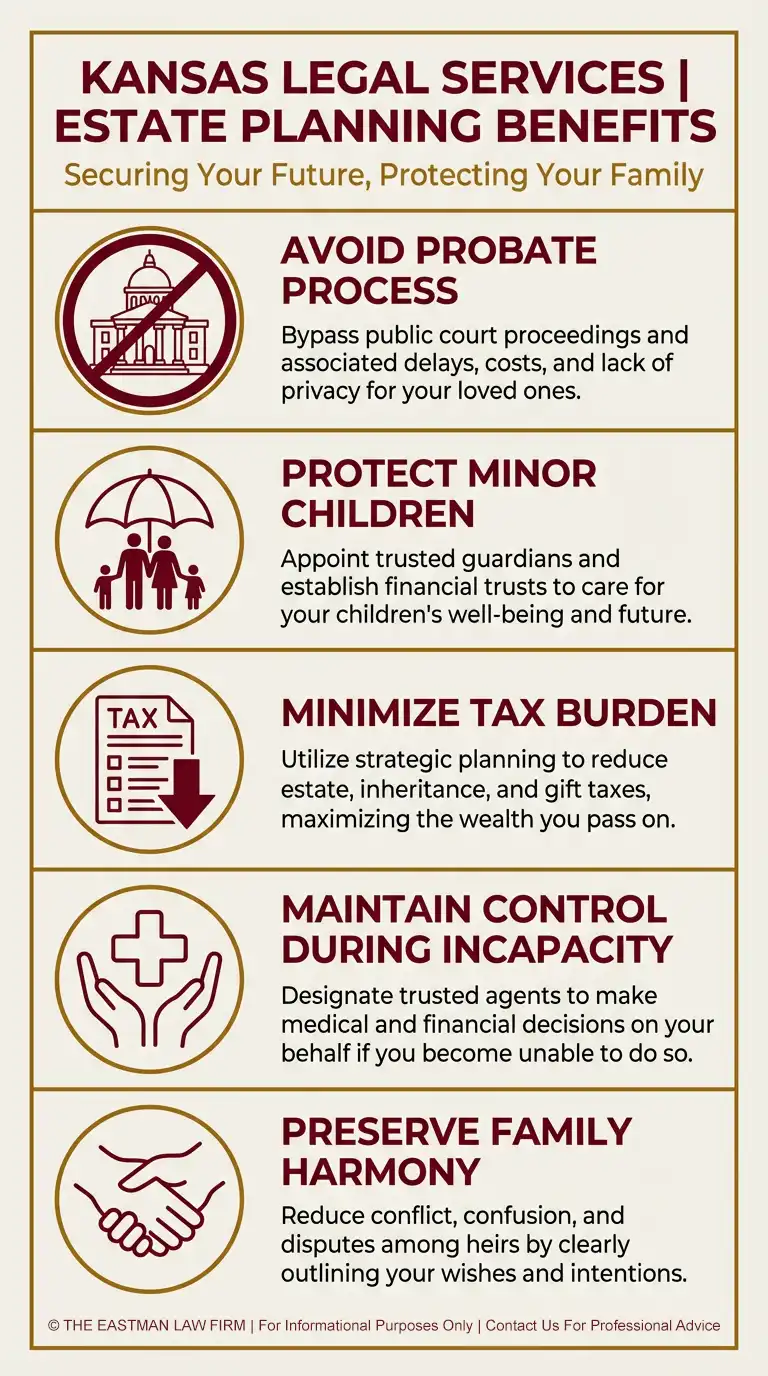
Avoid the Probate Process
Probate is the court-supervised process of distributing your estate after death. It’s time-consuming, expensive, and completely public. A well-structured estate plan, particularly one that includes a revocable living trust, allows your assets to pass directly to your beneficiaries without court intervention. Your family saves months of delays and thousands of dollars in court costs and attorney fees.
| Feature | Probate | Revocable Living Trust |
|---|---|---|
| Timeline | 6-18+ months | Days to weeks |
| Cost | 3-7% of estate value (ongoing) | 1-3% upfront (one-time) |
| Privacy | Public record (anyone can view) | Completely private |
| Court Involvement | Required for every step | None required |
| Incapacity Planning | ✗ No protection | ✓ Full protection included |
| Difficulty to Contest | Easier to challenge in court | More difficult to challenge |
| Real Estate in Multiple States | Separate probate in each state | Avoids all probate proceedings |
| Flexibility | Rigid court-controlled process | Can be modified anytime |
| Family Burden | Significant time, stress, and court appearances | Minimal burden on family |
Protect Your Minor Children
Through your estate plan, you designate guardians for your children if both parents pass away. You can also establish trusts that control how and when your children receive their inheritance, ensuring they’re financially protected but not overwhelmed with assets at too young an age. Without this planning, a court makes these decisions without knowing your family dynamics or your children’s needs.
Minimize Tax Burden
Strategic estate planning can significantly reduce estate taxes, gift taxes, and income taxes on inherited assets. Our tax planning strategies have saved Johnson County clients an average of over $500,000 in estate taxes. For Kansas residents, while the state doesn’t have an estate tax, federal estate taxes can still apply to larger estates. With proper planning, you can structure your estate to take advantage of exemptions, deductions, and strategic gifting to preserve more wealth for your family.
Maintain Control During Incapacity
Powers of attorney and healthcare directives ensure someone you trust can manage your finances and make medical decisions if you become incapacitated. Without these documents, your family may need to go to court to obtain guardianship or conservatorship, which is expensive, time-consuming, and invasive.
Preserve Family Harmony
Clear estate planning reduces ambiguity and the potential for family disputes. When your wishes are clearly documented and legally sound, there’s less room for interpretation, resentment, or conflict among your heirs. You’re giving your family clarity during an already difficult time.

Comprehensive Estate Planning Documents
Every estate plan we create is customized to your specific situation, but most comprehensive plans include (click on the “+” sign to learn more about each):
Last Will and Testament
Your will designates who receives your property, who serves as executor of your estate, and who becomes guardian of your minor children. Even if you have a trust, a will serves as a backup to catch any assets not transferred to the trust.
Revocable Living Trust
A trust allows your assets to pass to your beneficiaries without probate. It provides privacy, flexibility, and control over how and when your assets are distributed. You maintain complete control during your lifetime and can modify the trust as circumstances change.
Durable Power of Attorney
This document designates someone to manage your financial affairs if you become incapacitated. Your agent can pay bills, manage investments, handle real estate transactions, and make other financial decisions on your behalf.
Healthcare Directive (Living Will)
A healthcare directive communicates your wishes regarding life-sustaining treatment and other medical decisions. It ensures your preferences are known and legally enforceable if you’re unable to communicate them yourself.
Medical Power of Attorney (Healthcare Proxy)
This appoints someone to make healthcare decisions on your behalf if you’re incapacitated. Your healthcare agent works with doctors to make informed medical decisions consistent with your values and preferences.
Beneficiary Designations Review
We review all your beneficiary designations on retirement accounts, life insurance policies, and other assets to ensure they align with your overall estate plan. Improperly coordinated beneficiary designations can undermine your entire plan.
Asset Transfer Guidance
We provide detailed instructions on transferring assets to your trust, retitling property, and coordinating your estate plan with your existing financial accounts. Proper funding of your trust is critical to its effectiveness.
Estate Planning Packages and Pricing
Individual Basic Will
-
✓
Last Will and Testament -
✓
Durable Financial Power of Attorney -
✓
Healthcare Power of Attorney/Proxy -
✓
Living Will & HIPAA Waiver -
✓
Specific Gift List Form
Individual Trust Package
-
✓
Revocable Living Trust with Estate Tax Planning -
✓
Pour-Over Last Will and Testament -
✓
Both Powers of Attorney (Financial & Healthcare) -
✓
Living Will & HIPAA Waiver -
✓
Assignment of Tangible Personal Property -
✓
Specific Gift List Form -
✓
One (1) Real Estate Deed
Couple Basic Will
-
✓
Coordinated Wills for Both Spouses -
✓
Financial Powers of Attorney (Both) -
✓
Healthcare Powers of Attorney (Both) -
✓
Living Wills & HIPAA Waivers (Both) -
✓
Specific Gift List Forms
Couple Trust Package
-
✓
Joint Revocable Living Trust with Tax Planning -
✓
Pour-Over Wills (Both Spouses) -
✓
All Powers of Attorney (Financial & Healthcare for Both) -
✓
Living Wills & HIPAA Waivers (Both) -
✓
Assignment of Tangible Personal Property -
✓
Specific Gift List Forms -
✓
One (1) Real Estate Deed
Note: All packages include consultation, document preparation, review session, and signing appointment. Complex estates requiring additional planning may have additional fees, which we'll discuss during your consultation.
43% of Americans without a will said they “just have not gotten around to it” (procrastination), making it the top reason for not having an estate plan since 2022 (Caring.com 2024-2025 Wills and Estate Planning Studies).
Pitfalls That Can Undermine Your Plan
Procrastination
“I’ll do it later” is the most dangerous phrase in estate planning. Unexpected illness, accidents, or death can strike at any time. Without a plan in place, your family faces unnecessary legal complications, expense, and stress during an already difficult period.
DIY and Online Templates
Generic online forms and fill-in-the-blank documents rarely account for Kansas-specific laws, your unique family situation, or the complexity of your assets. Mistakes in these documents can make them legally invalid, create unintended tax consequences, or fail to accomplish your goals. The cost of fixing a poorly drafted estate plan far exceeds the cost of doing it right the first time.
Failing to Update Your Plan
Life changes require estate plan updates. Marriage, divorce, births, deaths, significant asset changes, business growth, and moves to different states all necessitate review and revision. An outdated estate plan can be worse than no plan at all if it no longer reflects your circumstances or wishes.
| Category | Update Triggers |
|---|---|
| FAMILY CHANGES (Update Immediately) | |
| Relationship Changes |
|
| Children & Family |
|
| FINANCIAL CHANGES (Update Within 6 Months) | |
| Asset Changes |
|
| Debt & Liabilities |
|
| LEGAL & PERSONAL CHANGES (Update as Needed) | |
| Named Individuals |
|
| Location & Laws |
|
| Health & Age |
|
| REGULAR MAINTENANCE (Review Every 3-5 Years) | |
| Scheduled Review | Even without major life changes, review your estate plan every 3-5 years to ensure it still reflects your wishes, complies with current laws, and accounts for any gradual changes in your life or assets. |
Not Funding Your Trust
Creating a trust is only half the job. If you don’t transfer assets to the trust (a process called “funding”), the trust provides no benefit. Assets not in the trust still go through probate, defeating the entire purpose of creating the trust.
Ignoring Tax Implications
Estate planning without considering tax consequences can result in your beneficiaries losing a significant portion of their inheritance to unnecessary taxes. Strategic planning can preserve substantially more wealth for your family.
Overlooking Digital Assets
In our digital age, cryptocurrency, online accounts, digital photos, and social media all have value and need to be addressed in your estate plan. Without proper planning, these assets can be lost or inaccessible to your family.

Experience That Makes the Difference
27 Years of Estate Planning Experience
Gary Eastman has practiced estate planning law since 1998. His career includes three years at Polsinelli, a top 100 AmLaw firm (2002-2005), where he worked on over 500 transactions ranging from $500,000 to $10 million, including multiple deals exceeding $100 million. This big-firm experience means sophisticated strategies, but delivered with the personal attention only a dedicated estate planning practice can provide.
Proven Results for Kansas Families
Numbers tell the story: 5,407 estate planning clients served, 1,257 wills drafted, 5,423 trusts created, and 143 probate cases successfully administered. Right here in Johnson County, we’ve helped 1,134 families protect their assets and plan for the future. Our tax planning strategies have saved clients an average of over $500,000 in estate taxes.
Serving Clients Across the Wealth Spectrum
Whether your estate is $500,000 or over $1 billion, you receive the same level of sophisticated planning. We’ve served clients with estates ranging from modest to over $1 billion, including multiple clients with hundreds of millions in assets. Every client deserves comprehensive protection, regardless of estate size.
J.D. and M.B.A. in Finance
Gary’s dual credentials, a law degree (J.D.) and an M.B.A. in Finance from the University of Kansas, provide a unique advantage. Estate planning isn’t just about legal documents; it’s about financial strategy, tax implications, and wealth preservation. This combination of legal expertise and financial acumen means more sophisticated planning for your family.
“Mr. Eastman really took the time to listen to us. He didn’t try and sell us on the most expensive option, but instead worked with us to determine what was right for our family.
I really believe that he cares about his clients and I truly appreciate all of his time.”
“I have worked with Gary and find him to be a highly respected estate planning attorney. He understands wills and trusts and makes things easy to understand.
I wholeheartedly recommend him.”
Estate Planning Questions Answered
Quick Reference
Business Name: The Eastman Law Firm
Address: 4901 W 136th St, Suite 240, Leawood, KS 66224
Hours: Monday through Friday, 8:00 AM to 5:30 PM
Phone: (913) 908-9113 - calls returned within 60 minutes (during business hours)
Parking: 45 free spaces including 6 ADA-accessible
Meetings: In-office or video conference available
Q: What is estate planning?
Estate planning is the process of legally arranging how your assets will be managed during your life and distributed after your death, while also planning for potential incapacity. A comprehensive estate plan includes wills or trusts, powers of attorney for financial and healthcare decisions, healthcare directives, guardianship designations for minor children, and strategies to minimize taxes and avoid probate.
Estate planning ensures your wishes are followed, your family is protected, and your assets pass efficiently to your chosen beneficiaries. Over 27 years, we’ve created 5,423 trusts and 1,257 wills for Kansas families, designing customized plans addressing your unique family situation, asset mix, and goals while ensuring full compliance with Kansas law.
Q: Who needs estate planning in Leawood?
Everyone over 18 needs estate planning, regardless of wealth. If you own a home, have retirement accounts, carry life insurance, have minor children, own a business, or simply want control over medical decisions if incapacitated, you need an estate plan. Young families need guardian designations. Homeowners need strategies to transfer property efficiently. Business owners require succession planning. Retirees need asset protection and tax minimization.
Common misconception: “I’m not wealthy enough for estate planning.” Reality: A modest home ($250,000), retirement accounts ($100,000), and life insurance ($250,000) creates a $600,000 estate requiring professional protection. Without proper planning, your family faces probate costs, delays, and uncertainty. We’ve served 5,407 clients across all wealth levels.
Q: What's the difference between a will and a trust?
A will only takes effect after you die and must go through probate court, while a revocable living trust takes effect immediately, allows you to manage assets during your lifetime, and avoids probate entirely. This is the most fundamental difference in estate planning.
A Last Will and Testament names who receives your property after death, designates guardians for minor children, and appoints an executor to handle your estate. However, wills must go through probate, a court-supervised process in Johnson County or Wyandotte County that typically takes 8 to 12 months and costs $3,000 to $8,000 in attorney fees and court expenses. During probate, your will becomes a public record accessible to anyone.
A revocable living trust holds your assets during your lifetime. You serve as trustee while alive and capable, your successor trustee takes over if you become incapacitated or die, and beneficiaries receive assets according to your instructions without court involvement. Trusts provide privacy, avoid the 8 to 12 month probate delay, eliminate probate costs, and allow seamless management during incapacity.
Q: How much does estate planning cost in Leawood, Kansas?
Our transparent pricing ensures you know exactly what to expect. Individual basic will packages start at $495, while couple packages start at $895. Revocable living trust packages are $1,995 for individuals and $2,495 for couples. These packages include all essential documents: wills, powers of attorney, healthcare directives, and for trust packages, deed preparation and trust funding assistance. We provide detailed pricing during your initial consultation based on your specific situation.
Q: How long does the estate planning process take?
From initial consultation to signed estate plan typically takes 4 weeks. The process includes initial 45 to 60 minute consultation to discuss your goals and situation, document preparation (10 to 14 days), review and revision period (3 to 5 days), and signing appointment (30 to 45 minutes). We work efficiently while ensuring every detail is correct, and we can accommodate urgent situations when needed. Trust funding (transferring assets into your trust) is completed within 2 weeks of signing.
Q: What is your track record with Kansas families?
Over 27 years since 1998, we’ve served 5,407 estate planning clients, creating 5,423 trusts and 1,257 wills for Kansas families. Right here in Johnson County, we’ve helped 1,134 families protect their assets and plan for the future. We’ve administered 143 probate estates, giving us deep understanding of both planning strategies that work and the problems that arise without proper planning. Our tax planning strategies have saved clients an average of over $500,000 in estate taxes. We return calls within 60 minutes during business hours and complete most estate plans within 4 weeks on average from initial consultation to signed documents.
Q: What are your office hours and response times?
Our office is open Monday through Friday, 8:00 AM to 5:30 PM. We pride ourselves on responsiveness. Calls are typically returned immediately, and always within 60 minutes during business hours. Our Leawood office at 4901 W 136th St Suite 240 offers 45 free parking spaces, including 6 ADA-compliant spaces, with ground-level access to our suite. We’re centrally located and easily accessible from throughout Johnson County, typically 5 to 20 minutes from most areas.
Q: What areas of Kansas do you serve other than Leawood?
We serve clients throughout the state and the Kansas City metro area from our Leawood office, with a primary focus on Johnson County and Wyandotte County. Estate planning clients come to us from across the region because Kansas law allows us to serve families anywhere in the state.
In Johnson County, we regularly serve families in Overland Park, Leawood, Olathe, Lenexa, Shawnee, Prairie Village, Mission, Merriam, Roeland Park, and Fairway. Johnson County probate cases are handled at the district court in Olathe, and we’re thoroughly familiar with the court’s procedures and requirements.
In Wyandotte County, we serve Kansas City KS, Bonner Springs, Edwardsville, and surrounding areas.
Q: Do I need a will or a trust?
The answer depends on your goals, assets, and family situation. Choose a will if you have a simple estate (under $200,000), few assets, no real estate or only homesteaded property, no concerns about privacy, and you’re comfortable with probate. Choose a trust if you own real estate, have significant assets ($200,000 or more), value privacy, want to avoid probate delays and costs, have minor children receiving inheritance, own property in multiple states, or have a blended family with complex distribution wishes.
Many clients initially seeking “just a simple will” discover trusts better serve their needs once they understand probate costs and delays. With 27 years of experience and 5,423 trusts created, we provide honest guidance on which approach best fits your situation and budget.
Q: What documents are included in an estate plan?
A comprehensive estate plan typically includes a Last Will and Testament or Revocable Living Trust, Durable Financial Power of Attorney, Durable Medical Power of Attorney (Healthcare Proxy), Healthcare Directive (Living Will), HIPAA Authorization, and Guardianship Designations (if you have minor children). Advanced plans may also include irrevocable trusts for tax planning or asset protection, business succession documents, and beneficiary designation reviews coordinating retirement accounts and life insurance with your overall plan.
Each document serves specific purposes. Your will or trust controls asset distribution. Powers of attorney authorize agents to make financial and medical decisions if you’re incapacitated. Healthcare directives communicate wishes about life-sustaining treatment. We prepare coordinated document packages ensuring everything works together seamlessly.
Q: What happens if I die without an estate plan?
If you die without a will or trust, you die “intestate,” meaning Kansas intestacy laws (not your wishes) determine who inherits your property. You lose all control over your estate.
Here’s what happens: The court decides who raises your minor children (a judge appoints a guardian based on what they think is best, which may not match your wishes), Kansas law determines who inherits (your spouse may not receive everything, your assets may go to relatives you don’t want inheriting, and unmarried partners receive nothing), the court appoints an administrator to handle your estate, and your estate goes through full probate in Johnson County or Wyandotte County (taking 8 to 12 months and costing $5,000 to $10,000 or more).
Without a trust, there’s no incapacity planning. The total cost to your family of dying without an estate plan typically exceeds $10,000 to $15,000 in legal fees and court costs, plus months or years of stress.
Q: When should I start estate planning?
Start estate planning as soon as you turn 18, get married, have children, buy a home, start a business, or accumulate significant assets. Estate planning isn’t about age or wealth; it’s about protecting what you have and the people who depend on you. Young adults need healthcare powers of attorney and living wills. Newlyweds need planning coordinating both spouses’ wishes. New parents must designate guardians immediately. Homeowners need strategies transferring property efficiently.
Common mistake: “I’ll do estate planning when I’m older.” Reality: Unexpected death or incapacity can strike at any age. Over 27 years serving 5,407 Kansas families, we’ve seen how proper planning provides peace of mind at every life stage. The best time to create your estate plan is now.
Q: What is probate and why should I avoid it?
Probate is the court-supervised process of administering your estate after death, and it’s public, expensive, and time-consuming. When someone dies with a will (or without any estate plan), their estate must go through probate in the county where they lived.
The probate process in Johnson County or Wyandotte County typically takes 8 to 12 months minimum for simple estates, 18 to 24 months for complex estates, and can take years if anyone contests the will. Probate costs typically run 3% to 7% of the estate value, including court filing fees, newspaper publication costs, attorney fees ($3,000 to $8,000 or more), executor fees, appraisal costs, and accounting fees. For a $500,000 estate, probate can easily cost $15,000 to $25,000.
Beyond cost and delay, probate is completely public. Anyone can see what you owned, what you owed, who inherited, and family disputes. A properly funded revocable living trust avoids probate entirely.
Q: How do I avoid probate in Leawood?
The most effective probate avoidance strategy is a properly funded revocable living trust. Assets titled in your trust name pass directly to beneficiaries without court involvement. Other strategies include transfer-on-death (TOD) designations for bank and investment accounts, beneficiary designations on retirement accounts and life insurance, transfer-on-death deeds for Kansas real estate, and joint ownership with right of survivorship (though this creates other risks).
The key is proper implementation. A trust doesn’t avoid probate unless you actually transfer assets into it (called “funding” the trust). Over 27 years creating 5,423 trusts for Kansas families, we’ve learned that trust funding is where many plans fail. We ensure your trust is properly funded and maintained.
Q: What's the difference between a Revocable Living Trust and an Irrevocable Trust?
A Revocable Living Trust can be amended, modified, or completely revoked by the Settlor (the person who created it) at any time during their lifetime. The Settlor typically serves as the initial Trustee, maintains complete control over trust assets, and can add or remove assets freely. However, because the Settlor retains control, a Revocable Living Trust offers no creditor protection during the Settlor’s lifetime and trust assets are included in the Settlor’s taxable estate.
An Irrevocable Trust cannot be easily changed or revoked once created. The Settlor transfers assets into the trust and relinquishes control to an independent Trustee. Because the Settlor no longer controls the assets, properly structured Irrevocable Trusts can provide significant creditor protection, remove assets from the taxable estate for estate tax planning purposes, and protect assets for beneficiaries. The choice depends on your specific goals.
Q: Do I need a trust if my estate is small?
Trust planning benefits estates of all sizes, not just large or wealthy estates. The question isn’t really about estate size, it’s about whether you want to avoid probate, protect your privacy, and ensure smooth management if you become incapacitated.
Even a “small” estate of $200,000 to $400,000 (a modest home, retirement accounts, and some savings) will cost your family $5,000 to $8,000 in probate fees and take 8 to 12 months to settle in Johnson County or Wyandotte County. A revocable living trust eliminates these expenses and delays regardless of estate size. The trust cost (typically $1,995 to $2,495 for individuals or couples) is almost always less than probate would cost.
Additional benefits include complete privacy, control over distributions, and protection from challenges. We’ve created trusts for Kansas families with estates ranging from $100,000 to over $100 million.
Q: What is a trustee and who should I choose?
A trustee is the person or institution responsible for managing trust assets and distributing them according to trust terms. For revocable living trusts, you typically serve as your own trustee during your lifetime, maintaining complete control. You name successor trustees who take over if you become incapacitated or die. For irrevocable trusts, you cannot serve as trustee.
Choosing successor trustees: Consider someone who is financially responsible, trustworthy, organized, available to serve, understands your wishes, and gets along with beneficiaries. This might be an adult child, sibling, close friend, or professional fiduciary. For complex estates or family situations, corporate trustees provide professional management, avoid family conflicts, and ensure continuity. We help you evaluate options and make appropriate selections.
Q: Can I be my own trustee?
Yes, for revocable living trusts, you serve as trustee and maintain complete control over all trust assets during your lifetime. You can buy, sell, invest, spend, and manage trust assets exactly as if they were in your personal name. Being your own trustee means no loss of control or access to your property. However, for irrevocable trusts (used for advanced tax planning or asset protection), you generally cannot serve as trustee. You also name successor trustees who take over if you become incapacitated or die.
Q: How does a trust work?
A trust is a legal arrangement where one person (the grantor/settlor) transfers assets to be held by another person (the trustee) for the benefit of designated people (the beneficiaries). For revocable living trusts (most common), you are typically all three roles during your lifetime: you create the trust (grantor), you manage the assets (trustee), and you benefit from the assets (beneficiary). You maintain complete control and can change or revoke the trust anytime.
When you die or become incapacitated, your named successor trustee takes over, managing trust assets and distributing them according to your instructions. Because the trust (not you personally) owns the assets, they don’t go through probate. Over 27 years, we’ve created 5,423 trusts for Kansas families.
Q: What assets should go into my Leawood trust?
Most assets should be transferred directly into your trust, but retirement accounts and life insurance policies require a different approach. Understanding which assets to retitle and which to name the trust as beneficiary is critical for proper trust funding.
Assets that should be retitled to the trust include real estate (primary residence, rental properties, vacation homes, land), bank accounts and credit union accounts, brokerage and investment accounts, business interests (LLC membership interests, partnership interests, closely-held corporation shares), certificates of deposit, and tangible personal property (vehicles, jewelry, artwork, collectibles).
Assets that should NOT be retitled but should name the trust as beneficiary include retirement accounts (401(k)s, IRAs, 403(b)s, pension plans), life insurance policies, health savings accounts (HSAs), and certain annuities. For these accounts, you complete a beneficiary designation form naming your trust as primary or contingent beneficiary.
The most common trust funding mistake: creating a trust but never transferring assets into it. An unfunded trust is worthless.
Q: Do I need both a Durable Financial Power of Attorney and a Durable Medical Power of Attorney?
Yes, we strongly recommend both documents as part of comprehensive estate planning and incapacity planning. A Durable Financial Power of Attorney authorizes someone you trust to manage your financial affairs, pay bills, access bank accounts, manage investments, and handle other financial matters if you become incapacitated. The “durable” designation means the Power of Attorney remains effective even if you become mentally incapacitated.
A Durable Medical Power of Attorney (also called a Healthcare Power of Attorney or Healthcare Proxy) is a separate document that authorizes someone to make medical and healthcare decisions on your behalf if you cannot communicate your wishes. This includes decisions about medical treatments, surgery, medication, and end-of-life care.
These are distinct legal documents serving different purposes, and you should have both. The person you designate for financial decisions does not automatically have authority to make healthcare decisions, and vice versa. You can name the same person for both roles or different people.
Q: How do I choose guardians for my children?
Choosing guardians for minor children is one of the most important and difficult decisions in estate planning. There’s no perfect answer, but focusing on your children’s wellbeing (not family politics) leads to the right choice.
Key factors include shared values and parenting philosophy (will they raise your children with your beliefs about education, religion, discipline, and life priorities?), capacity to raise children (do they have the time, energy, health, and financial stability?), age and life stage (are they young enough to raise children to adulthood but mature enough to handle the responsibility?), existing relationship with your children (do your children already know, love, and trust this person?), and geographic stability (would your children need to move far from their school, friends, and community?).
Critical steps: Name at least two alternates, discuss your decision with all named guardians before finalizing your will, and review your choice every few years as circumstances change.
Q: What happens to my minor children if I die?
If you die without legal guardian designations, the court decides who raises your children, which may not align with your wishes. Proper estate planning includes nominating guardians in your will or trust, naming successor guardians if first choices cannot serve, providing instructions about children’s care and upbringing, establishing trusts protecting inheritance until children reach responsible ages, ensuring adequate life insurance funding children’s care and education, and coordinating guardian nominations with financial provisions.
Guardian designation is the single most important estate planning decision for parents of minor children. Courts give significant weight to your written nominations but aren’t bound by them. Clear documentation combined with conversations with proposed guardians provides maximum protection.
Q: Who should be beneficiaries in my Leawood estate plan?
Your beneficiaries are the people or organizations who receive your assets after death, and you have complete freedom to choose them. Most people name spouses, children, grandchildren, other family members, close friends, or charitable organizations. You can leave assets outright (beneficiaries receive them immediately) or in trust (providing protection, controlling timing of distributions, or protecting beneficiaries from creditors, divorces, or poor financial decisions).
Important considerations: Name contingent beneficiaries (who receives assets if primary beneficiaries predecease you), consider per stirpes versus per capita distribution, address unequal distributions if treating children differently, provide for special needs family members without disqualifying them from government benefits, and consider charity as partial beneficiary for tax benefits.
Q: What if I have a blended family?
Blended families require careful estate planning to balance providing for your current spouse while protecting inheritances for children from previous relationships. Common concerns include ensuring children from prior marriages receive intended inheritances, providing for your current spouse during their lifetime, preventing your spouse from disinheriting your children after your death, addressing tensions between spouse and children, and treating all children fairly.
Solutions include Qualified Terminable Interest Property (QTIP) trusts providing income to surviving spouse for life with remainder to your children, irrevocable life insurance trusts ensuring children receive life insurance proceeds regardless of future changes, clear separate property agreements distinguishing premarital assets from marital property, and specific trust provisions controlling distributions and preventing changes after your death. We’ve helped numerous Johnson County families navigate these sensitive dynamics.
Q: Can I disinherit someone?
In Kansas, you can disinherit anyone except your spouse (who has statutory rights to a portion of your estate). To disinherit someone effectively, you must explicitly state your intention in your will or trust. Simply omitting someone isn’t enough; you need clear language: “I intentionally make no provision for [name]” or “I specifically disinherit [name].” This prevents them from claiming you forgot them or made a mistake.
Special considerations: Disinheriting children requires careful documentation to prevent will contests. Disinheriting a spouse is more complex (Kansas law provides spousal elective share rights allowing spouses to claim a portion of the estate regardless of will provisions). Disinheritance often creates family conflict and potential litigation, so clear documentation helps prevent disputes.
Q: What if my spouse and I die together?
Simultaneous death clauses in wills and trusts address common disaster scenarios where spouses die together or in quick succession. These provisions establish presumptions (often “my spouse is presumed to have predeceased me”) determining asset flow. Without planning, assets might pass to your spouse’s family rather than yours, or distribution might not reflect your true wishes.
Comprehensive planning includes simultaneous death provisions in both spouses’ documents, contingent beneficiary designations addressing scenarios where primary beneficiaries predecease you, backup guardian nominations for minor children, and coordinated estate planning ensuring assets ultimately benefit intended beneficiaries even in worst-case scenarios. While no one wants to think about disaster scenarios, proper planning ensures your family is protected even in the worst circumstances.
Q: Can my estate plan help reduce taxes?
Yes, strategic estate planning can significantly reduce or eliminate federal estate taxes, minimize gift taxes, and reduce income taxes on inherited assets. However, tax planning strategies vary dramatically based on your estate size and goals.
For estates under the current federal estate tax exemption ($13.61 million per person in 2024, $27.22 million for married couples), the focus shifts to income tax planning: maximizing the step-up in basis at death (eliminating capital gains taxes on appreciated assets), strategically timing asset sales and distributions, and coordinating retirement account beneficiary designations to minimize income taxes.
For estates exceeding the exemption, advanced strategies include lifetime gifting to remove assets from your taxable estate, irrevocable life insurance trusts, grantor retained annuity trusts (GRATs), qualified personal residence trusts (QPRTs), and charitable remainder trusts. Gary Eastman’s M.B.A. in Finance from the University of Kansas provides the financial expertise most estate planning attorneys lack. Over 27 years, our tax planning strategies have saved Kansas clients an average of over $500,000.
Q: What about retirement accounts in estate planning?
Retirement accounts (401(k)s, IRAs, 403(b)s, pensions) pass directly to named beneficiaries through beneficiary designations, not through your will or trust. This makes beneficiary designation forms critically important. Common mistakes include naming your estate as beneficiary (forcing accounts through probate and accelerating income taxes), naming minor children directly (requiring court-supervised guardianship), forgetting to update beneficiaries after divorce or other life changes, and failing to coordinate retirement account beneficiaries with overall estate plan.
Best practices: Name specific individuals as primary beneficiaries, name contingent beneficiaries in case primaries predecease you, consider naming trusts as beneficiaries for minor children or beneficiaries needing protection, understand required minimum distribution (RMD) rules for inherited accounts, and coordinate with spouse’s retirement accounts. Retirement accounts often represent significant estate value. We review all beneficiary designations during estate planning.
Q: How does life insurance fit into estate planning?
Life insurance provides immediate liquidity to pay estate settlement costs, replace lost income, pay off debts, equalize inheritances among children, or fund buy-sell agreements for business owners. Life insurance passes directly to named beneficiaries through beneficiary designations, avoiding probate. Proceeds are generally income tax-free to beneficiaries, making life insurance an efficient wealth transfer vehicle.
Advanced strategies: Irrevocable Life Insurance Trusts (ILITs) remove insurance from your taxable estate (important for estates exceeding federal exemption limits), protect proceeds from beneficiaries’ creditors and divorces, and provide professional management of large insurance proceeds. Name trusts as beneficiaries (not minor children directly) to avoid court guardianship. We help clients throughout Johnson County and Wyandotte County integrate life insurance strategically into estate plans.
Q: When should I update my estate plan?
Review your estate plan at least every 3 to 5 years and update it immediately after major life changes. Estate plans aren’t “set it and forget it” documents.
Life events requiring immediate updates include marriage, divorce, or remarriage, birth or adoption of children or grandchildren, death of a named beneficiary, executor, trustee, or guardian, significant change in assets (inheritance, business sale, real estate purchase), business formation or sale, health diagnosis affecting you or a fiduciary, and relocation to another state. Kansas law changes can also require updates. Financial institutions sometimes reject powers of attorney or other documents that are more than 5 to 7 years old, suspecting they might have been revoked or that the signer may no longer have capacity.
Even if nothing in your life has changed, periodic review ensures your documents remain current and enforceable throughout Johnson County and Wyandotte County.
Q: What information do I need for my consultation at your Leawood office?
Bring information about your assets, family situation, and any existing estate planning documents. Helpful information includes list of assets (real estate, bank accounts, investment accounts, retirement accounts, life insurance, business interests) with approximate values, information about family members (spouse, children, grandchildren, others you want to benefit), existing wills, trusts, or powers of attorney (even if outdated), information about any special circumstances (blended family, special needs family members, business ownership), and questions you want addressed.
Don’t worry about having everything perfectly organized. We’ll guide you through the process. The initial consultation focuses on understanding your situation, goals, and concerns, then recommending appropriate planning strategies and providing transparent fee quotes. We return calls within 60 minutes during business hours.
Q: I own a business - what special planning do I need?
Business owners need integrated planning addressing both business succession (who takes over the business) and personal estate planning (protecting personal and family assets). Key elements include buy-sell agreements determining what happens to business ownership if you die or become disabled, business valuation for estate tax and buyout purposes, entity structuring providing liability protection and tax efficiency, key person life insurance funding business continuity and buyouts, and coordination between business succession and personal estate planning.
Without planning, your business might be forced into liquidation, your family might lose business value, or estate taxes might force business sale. With Gary’s M.B.A. in Finance and 27 years of experience including three years at Polsinelli (AmLaw 100 firm) working on over 500 transactions, we understand both the legal and business aspects of succession planning.
Q: What if I own property in multiple states?
Owning real estate in multiple states without a trust means your family faces multiple probate proceedings after your death, one in each state where you own property. This multiplies the cost, delay, and complexity exponentially.
If you’re a Kansas resident with a will and you own a vacation home in Colorado, a rental property in Arizona, and undeveloped land in Arkansas, your estate will go through four separate probate proceedings: one primary probate in Johnson County or Wyandotte County (where you lived), plus three “ancillary probate” proceedings in Colorado, Arizona, and Arkansas. Each state charges separate filing fees, requires a separate attorney licensed in that state, and follows that state’s probate procedures. Total costs can easily reach $15,000 to $30,000 or more, and the process can take 12 to 24 months.
A properly funded revocable living trust eliminates all of these probate proceedings because the trust owns the real estate, not you personally. The out-of-state property transfers happen simultaneously with your Kansas assets, typically within 4 to 8 weeks.
Q: Can I create my own estate plan with online forms?
Yes, you can legally create estate planning documents using online services, but we regularly see these documents fail when families need them most. Online forms create three major problems: legal invalidity, missed opportunities, and false security.
Common failures include Kansas-specific requirements missing (improper witness signatures, missing notarization, outdated statutory language that financial institutions reject), assets not properly coordinated (life insurance beneficiaries conflicting with will provisions, retirement accounts going to wrong people, real estate titles not matching estate plan), and critical provisions overlooked (no incapacity planning, guardianship nominations that don’t comply with Kansas law, tax planning opportunities completely missed).
We’ve helped multiple families who spent $200 on online documents, only to spend $8,000 fixing problems after a death or during incapacity. Online forms can’t account for your specific situation. The question isn’t whether you can use online forms (you can), but whether they’ll actually work when your family needs them.
Q: I'm too young for estate planning - right?
Wrong. Every adult needs estate planning regardless of age. If you’re 18 or older, you need healthcare powers of attorney and living wills (your parents lose decision-making authority when you turn 18). If you’re married, you and your spouse need coordinated planning. If you have children, you absolutely need guardian designations and asset protection for their inheritance. If you own a home, you need strategies to transfer it efficiently. If you have retirement accounts or life insurance through work, you need proper beneficiary designations.
Real talk: Accidents, unexpected illness, and tragedy don’t wait until you’re “old enough” for estate planning. A 25-year-old in a coma needs someone with legal authority to make medical decisions. A 30-year-old with young children who dies unexpectedly needs guardian designations protecting those children. A 35-year-old homeowner who dies intestate leaves their family facing months of probate. Over 27 years serving 5,407 Kansas families, we’ve seen how proper planning provides protection and peace of mind at every age and life stage.
Our Suite Of Legal Services for Every Stage of Life
Life changes. Your estate plan should too. Whether you’re planning ahead or managing an estate after loss, from creating your first estate plan to administering complex trusts, we provide the guidance Kansas families need.
ESTATE PLANNING →
You’re in the right place on this page. Build a custom legal framework designed to bypass the delays of probate, from living trusts to asset protection, so your legacy transitions to your heirs on your terms and without administrative friction.
WILL PREPARATION →
Your estate plan needs a legal anchor. A professionally drafted will locks in your guardian designations and asset distribution instructions, giving the rest of your planning framework a binding foundation that holds up in court.
POWERS OF ATTORNEY →
Your estate plan protects your assets, but who protects you? Establish durable directives now that give a trusted person immediate authority over your medical and financial decisions if you become unable to manage them yourself, bypassing costly court intervention.
PROBATE ADMINISTRATION →
Even well-structured estate plans can involve court proceedings. When they do, hand off the legal weight of filings, creditor notices, and local probate requirements so the estate is settled accurately and your family avoids personal liability.
ASSET PROTECTION →
Your estate plan organizes your assets, but it also needs to defend them. Implement specific structures like irrevocable trusts and business entities that shield your holdings from future creditors and legal claims so everything you’ve built stays available for your family.
TRUST MANAGEMENT →
An estate plan is only as strong as its maintenance. Whether you’re navigating current trust administration or need to update existing documents to reflect new family dynamics or changes in the law, keep your legal structures aligned and fully enforceable.
TAX & FINANCIAL PLANNING →
Don’t let taxes undermine the estate plan you’ve built. Integrate tax-efficient strategies into your legal framework so your beneficiaries receive the full benefit of your planning instead of losing a significant portion to estate and inheritance taxes.
BUSINESS SUCCESSION →
If you own a business, your estate plan is incomplete without a succession strategy. Codify a clear transition plan that protects the company’s value, provides your successors with legal operating authority, and prevents your departure from creating a financial crisis for your family.
START YOUR PLAN →
Move from uncertainty to a concrete legal strategy. Schedule a consultation to review your current holdings and identify the specific structures needed to protect your family and your business across the Kansas City metro area.
Kansas-Specific Estate Planning Considerations
Kansas Intestacy Laws
If you die without a will in Kansas, state intestacy laws dictate how your property is distributed. If you’re married with children, your spouse receives half and your children split the other half. If you have no spouse or children, property goes to parents, siblings, or more distant relatives. These default rules rarely align with what people actually want, which is why having a will or trust is essential.
Kansas Probate Process
Kansas offers both formal and simplified probate procedures. Estates valued under $40,000 may qualify for a simplified small estate affidavit process. Larger estates typically go through formal probate, which in Kansas can take 6-12 months or longer depending on complexity. Court costs, executor fees, and attorney fees typically consume 3-7% of the estate value. Proper planning through trusts avoids this entirely.
Kansas Estate Tax Considerations
Kansas does not have a state estate tax or inheritance tax, which simplifies planning compared to some states. However, federal estate taxes still apply to estates exceeding the federal exemption (currently $13.61 million per individual in 2024, but subject to change). Kansas residents with substantial estates should engage in strategic planning to minimize federal estate tax exposure.
Homestead Protections
Kansas law provides homestead protections that can shield your primary residence from certain creditors. Proper estate planning incorporates these protections while ensuring your home passes efficiently to your beneficiaries without probate.
Community Property vs. Common Law State
Kansas is a common law property state, not a community property state. This means property acquired during marriage isn’t automatically owned 50/50 by spouses. Instead, property belongs to whoever holds title or whose earnings purchased it. This distinction affects estate planning, particularly for married couples, and requires careful coordination of ownership and estate documents.
Let’s Meet And Discuss Your Options
Our Leawood office at 4901 W 136th St Suite 240 is centrally located to serve all of Johnson County and the greater Kansas City metro area. We’re just minutes from Overland Park, Olathe, Lenexa, Shawnee, and Prairie Village, with 45 free parking spaces including 6 ADA-compliant spaces and ground-level access to our suite. Most Johnson County clients reach us in 5-20 minutes, making it convenient to meet for consultations, document signing, and ongoing estate planning needs.
Ready to Protect Your Family’s Future?
Your Next Steps:
1. Schedule Your Consultation
Contact us today to arrange an initial meeting where we’ll discuss your family situation, assets, goals, and concerns. This is your opportunity to ask questions and understand your options.
2. Gather Relevant Information
Before your consultation, gather information about your assets (real estate, bank accounts, investments, business interests), existing estate planning documents, insurance policies, and retirement accounts. This helps us provide comprehensive guidance.
3. We’ll Create Your Custom Plan
Based on your consultation, we’ll design an estate plan tailored to your specific needs. We’ll explain every document and decision, ensuring you understand and are comfortable with your plan.
4. Sign Your Documents
Once your documents are prepared and reviewed, we’ll meet for signing. We ensure all documents are properly executed according to Kansas law.
5. Fund Your Trust and Implement Your Plan
We’ll guide you through transferring assets to your trust and coordinating beneficiary designations. Proper implementation is critical to ensuring your plan works as intended.
Additional Resources:
- Review our Probate Administration services to understand what your family faces without proper planning
- Explore Asset Protection strategies to shield your wealth
- Learn about Trust Management for ongoing administration
Serving Families Throughout Johnson County
The Eastman Law Firm proudly serves families across Johnson County and the greater Kansas City metropolitan area. Wherever you are in our community, we're here to help.
Don’t Leave Your Family’s Future to Chance
Every day you wait is another day without protection for the people you love. Estate planning isn’t something to put off until “someday.” It’s something to do now, while you have the capacity to make these important decisions.
At The Eastman Law Firm, we make estate planning clear, straightforward, and actually achievable. You’ll work directly with Gary Eastman, an attorney who combines big-firm expertise with personal attention and genuine care for your family’s wellbeing.
Schedule your consultation today. Your family deserves the security and peace of mind that comes from knowing you’ve planned ahead.
27 years of estate planning experience • 5,407 clients served • 1,134 Johnson County families • Calls returned within 60 minutes • 4 weeks from consultation to signed plan
The Eastman Law Firm, As Seen On:


Schedule Your Estate Planning Consultation Today
Or Fill Out The Form Below:
NOTE: Information found on TheEastmanLawFirm.com is for general informational purposes only and should not be construed as legal advice nor a solicitation of legal business. No attorney-client relationship attaches as a result of any exchange of information, including this form or emails that are sent to the Firm. Please do not send us confidential information or sensitive materials. Unsolicited information that you send to us will not be regarded as confidential unless we have agreed to represent you. If you send an email or submit this form, you confirm that you have read and understood this notice.