
Probate led by an estate-planning attorney, serving local families since 1998.
Probate Attorney in Leawood, Kansas
“Some probates are straightforward. Others are unbelievably complicated. After 27 years, my job hasn’t changed: tell families the truth, then do the work.” — Gary Eastman
You’re On The Hook…
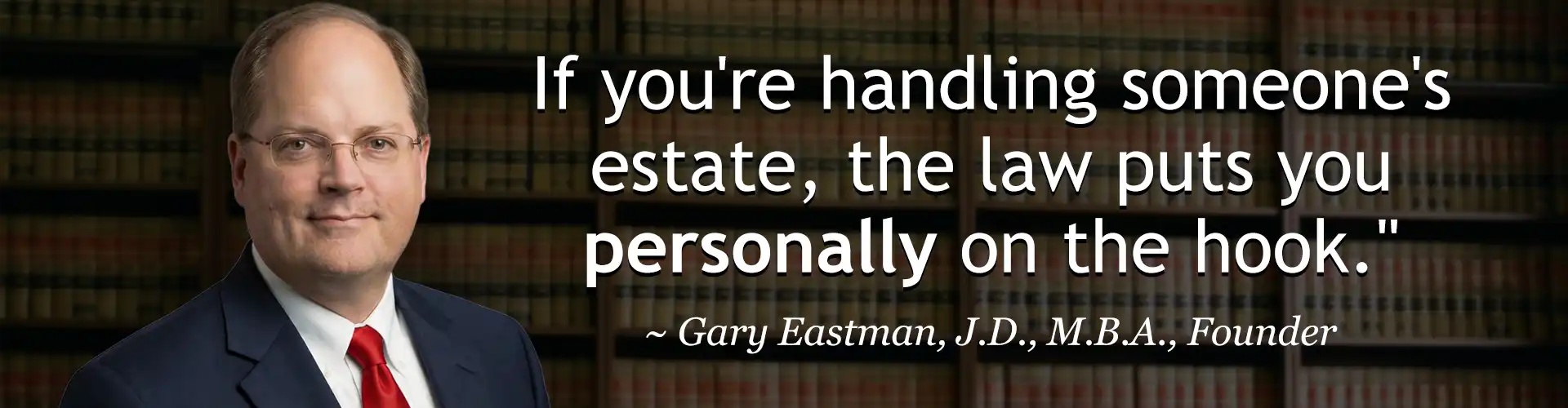
If you’re handling someone’s estate, the law puts you personally on the hook.
When a Kansas court appoints you as executor or administrator, you become a fiduciary.
Not the estate. You.
Your name, your assets, your reputation. If something goes wrong on your watch, the consequences land on you personally, not on the estate you’re trying to settle.
Kansas law gives you nine months from the date of your appointment to settle the estate. Miss that window and, under K.S.A. 59-1501, you’re not relieved from “any loss, liability, or penalty” caused by the delay.
The statute is direct about it. The court extends the deadline only for cause, and even then, you’re still on the line for what went wrong while the clock was running.

The exposure runs in four directions.
- Creditors can come after you personally if you distribute assets before their claims are resolved.
- Beneficiaries can sue you for breach of fiduciary duty if you mishandle estate property, miss a tax filing, or distribute unfairly.
- The court can remove you, deny your compensation, or surcharge you for losses you caused.
- The IRS and the Kansas Department of Revenue can hold you personally responsible for unpaid taxes if you distributed estate funds before paying them.
THE GOOD NEWS: With the right attorney, none of this lands on you. That’s our entire job. Keep you out of all four directions, settle the estate, and hand the executor’s hat back when it’s done.
Before you make a decision you can’t undo, talk to Gary.
What happens when you contact us
Most people who call us have never hired a probate attorney before. Here’s exactly what happens, step by step, so you know what you’re walking into.
- You call us. Gary or someone on his team returns your call within 60 minutes during business hours.
- We schedule the 15-minute phone consultation, usually within two business days. No office visit yet, no commitment.
- On the call, Gary asks the questions that matter. Where the deceased lived, what assets are involved, whether there’s a will, whether the family is on the same page. By the end, you’ll have a realistic picture of what’s involved and a fee range.
- If it makes sense to move forward, we schedule an in-office meeting and send you a written engagement letter before any work begins.
If after the 15-minute call you decide we’re not the right fit, that’s fine. You’ll still know more about your situation than you did 15 minutes earlier, at no cost.
Do you actually need probate?
Not every estate needs probate. Some assets transfer automatically. Others can’t move without it.
Look down the table below and check each asset against what your loved one actually owned. If everything they had falls in the top half (avoids probate), you may not need to open a case at all.
If anything falls in the bottom half, probate is probably your path. Most estates land somewhere in the middle, which is why it’s worth a 15-minute phone call before you assume anything.
| Asset Type | |
|---|---|
| ✓ AVOIDS PROBATE (Transfers Automatically) | |
| ✓ | Assets in Revocable Living Trust - Property transferred to your trust avoids probate entirely and passes directly to beneficiaries. |
| ✓ | Life Insurance with Named Beneficiary - Proceeds go directly to designated beneficiaries without court involvement. |
| ✓ | Retirement Accounts (IRA, 401k, 403b) - Accounts with designated beneficiaries transfer automatically outside of probate. |
| ✓ | Payable-on-Death (POD) and Transfer-on-Death (TOD) Accounts - Bank accounts (POD), brokerage accounts, and investment accounts (TOD) with named beneficiaries transfer directly to them without probate. |
| ✓ | Jointly Owned Property with Right of Survivorship - Property automatically transfers to surviving co-owner(s). |
| ✓ | Assets Owned by Corporation or LLC - Business entities continue operating; ownership interests typically require probate without proper planning. |
| ✗ REQUIRES PROBATE (Court Process Needed) | |
| ✗ | Real Estate in Deceased’s Name Only - Property titled solely to the deceased must go through probate for transfer. |
| ✗ | Bank Accounts, Vehicles, and Personal Property in Deceased’s Name Only - Solely-owned bank accounts (no POD or joint ownership), vehicles like cars, boats, and RVs, and personal items like jewelry, furniture, and collectibles all require probate to transfer. |
| ✗ | Business Interests Without Succession Plan - Sole proprietorships and partnership interests typically require probate. |
| ✗ | Assets with No Clear Ownership Documentation - Property with unclear or disputed ownership must be resolved through probate. |
If you’re not sure where your situation lands, that’s normal. The first thing we do on a call is help you figure that out.
How probate works in Kansas, and how long it takes.
The Kansas probate administration process typically takes 6 to 12 months from the date the court appoints you. Some of that time is paperwork. Some is mandatory waiting. The single longest waiting period (four months for creditors to file claims) is required by Kansas law and cannot be shortened, no matter how organized you are or how fast your attorney works.
Here’s what each phase looks like and roughly when it happens.
| Timeframe | Phase | What Happens |
|---|---|---|
| Month 1-2 | Filing & Appointment | Court filing, will validation, and executor appointment. We prepare and file all necessary documents to open the probate case and obtain legal authority. |
| Month 2-3 | Inventory & Notice | Asset identification and creditor notification published. We help compile a complete inventory of estate assets and publish required legal notices. |
| Month 4-6 | Creditor Claim Period | Mandatory 4-month creditor claim period (cannot be rushed). Kansas law requires this waiting period for creditors to file claims against the estate. |
| Month 6-9 | Estate Administration | Pay debts, file taxes, and manage estate assets. We handle creditor claims, coordinate tax filings, and ensure proper asset management. |
| Month 9-12 | Distribution | Final accounting, court approval, and asset distribution. We prepare the final accounting and facilitate distribution to beneficiaries after court approval. |
| Month 12+ | Estate Closure | Estate officially closed and executor discharged. We file final documents to formally close the estate and release the executor from further responsibility. |
When probate closes successfully, the estate is settled, beneficiaries have received what the will or Kansas law directs, and the executor is formally discharged from further responsibility. That’s the destination. The path varies by case.
How much does a probate lawyer cost in Kansas?
Honest answer: it depends. Probate fees vary based on the complexity of the estate, how organized the records are, how much real estate is involved, whether there are disputes among beneficiaries, and how cooperative everyone wants to be.
Anyone who quotes you a fixed probate fee before knowing your situation is either lowballing you or planning to bill you for “extras” later.
Here’s how we structure fees, what we charge, and how we keep you out of the surprise-bill trap.
Probate done alone or with the wrong attorney
- Personal liability for executor mistakes under K.S.A. 59-1501
- Missed deadlines, creditor claim errors, improper distributions
- Often billed entirely at top attorney rate, even for routine work
- Surprise bills, no engagement letter
- Estate often stays open 18 to 24+ months instead of closing efficiently
Estate-planner-led probate with Eastman
- Free 15-minute phone consultation before you commit to anything
- Written engagement letter before any work begins
- Attorney work billed at $350 to $490 per hour, depending on which attorney handles it
- Paralegal work billed at $150 to $190 per hour, because routine work shouldn’t be billed at attorney rates
- Calls returned within 60 minutes during business hours
A 15-minute call lets us understand the basics of your case, give you a realistic picture of what’s involved, and quote you a fee range before either of us commits to office time.
If your situation is straightforward, we’ll tell you. Some probates can get unbelievably complicated, and if yours looks like one of those, we’ll tell you that too, along with what it’s likely to mean for time and cost.
Get a real fee range before you commit to anything.
Probate costs typically range from 3% to 7% of the total estate value, with attorney fees ranging from $150 to $500 per hour; the average probate timeline in the United States is 20 months. (Trust & Will Probate Study / SmartAsset Analysis).
Questions we get before the probate consultation
Do I even need probate?
Maybe not. If everything the deceased owned was held in a revocable living trust, in joint ownership with right of survivorship, or in accounts with named beneficiaries (life insurance, retirement accounts, payable-on-death bank accounts), those assets transfer outside probate. If anything was titled solely in the deceased's name without a beneficiary designation, that asset typically requires probate to transfer. The asset table above is the fastest way to check. If you're unsure, a 15-minute phone call will tell you for certain.
What does probate cost?
Probate fees in Kansas vary based on case complexity. We bill hourly: $350 to $490 per hour for attorney work depending on which attorney handles it, and $150 to $190 per hour for paralegal work, because routine work shouldn't be billed at attorney rates. Anyone quoting you a fixed fee before knowing your case is either lowballing you or planning to bill you for "extras" later. After a 15-minute call, we can give you a realistic fee range based on what your situation actually involves.
How long does probate take in Kansas?
Most Kansas estates close in 6 to 12 months from the date the executor or administrator is appointed. Kansas law requires a mandatory 4-month creditor claim period that cannot be shortened, no matter how organized the estate is. Complicated cases involving disputed wills, missing assets, business interests, blended families, or real estate in multiple states can run 18 to 24 months or longer. The full timeline by phase is in the table above.
What happens if I make a mistake as executor?
Kansas executors are personally liable for fiduciary errors. Distributing assets before creditor claims are resolved, missing court deadlines, mishandling tax filings, or commingling estate funds with your own can expose your personal assets to creditor claims, beneficiary lawsuits, court surcharge, or IRS pursuit. This is why most executors hire an attorney. The attorney's job is mostly to keep you out of the four directions where personal liability lives.
Can I handle probate myself in Kansas?
Legally, yes. Kansas does allow executors to administer probate without an attorney for simpler estates. Practically, the question is whether the savings are worth the personal liability exposure. Estates with real estate, business interests, multiple beneficiaries, creditor disputes, or tax considerations almost always benefit from professional handling. The 15-minute call is where we figure out which type yours is. If your situation is simple enough to do alone, we'll tell you that on the call.
The estate already has another attorney. Can you take over?
Yes. Switching probate counsel mid-case is allowed in Kansas, and we do it regularly when families aren't satisfied with their current representation. The most common reasons are slow response times, surprise bills, or feeling like the attorney is processing the estate as a transaction rather than guiding the family. We'll review where the case stands, what's been done, and what still needs to happen, then give you a realistic picture of the transition before you decide.
What documents should I bring to the consultation?
If you have them: the original will (if there is one), a death certificate, a list of the deceased's assets and approximate values (real estate, bank accounts, investment accounts, retirement accounts, business interests), a list of known debts and creditors, names and contact information for beneficiaries, and any prior estate planning documents (trusts, prior wills, powers of attorney). If you don't have all of this yet, that's fine. The phone consultation works without it.
What are your hours and how fast do you return calls?
Office hours are Monday through Friday, 8:00 AM to 5:30 PM Central. New inquiries during business hours receive a callback within 60 minutes on average. After hours and weekend messages are returned the next business morning. The Leawood office at 4901 W 136th Street, Suite 240, has 45 free parking spaces including 6 ADA-compliant spots. Most consultations from new probate inquiries are scheduled within 2 business days.
Can we do everything by phone or video instead of coming to the office?
The 15-minute initial consultation is by phone, not in person. After that, most ongoing probate work can be handled remotely if that's what works best for you, including Zoom meetings, document signing by mail or electronic signature, and phone updates on case status. Court appearances when required are handled by us, not by you. Out-of-state executors handling Kansas estates are common in our practice and we're set up for that.
Why families trust The Eastman Law Firm with probate

Probate firms tend to fall into two categories: high-volume mills that process estates as transactions, and generalist family attorneys who handle probate as a side practice.
Eastman is neither. Here’s what makes the difference.
Big-Firm Training
Gary spent the early years of his career at Polsinelli, one of the top 100 law firms in the United States, where he handled more than 500 transactions ranging from $500,000 to $10 million and several over $100 million.
The drafting precision, deadline discipline, and document standards from that environment carry into every probate matter we handle today, on cases of any size. Most solo and small-firm probate attorneys in Kansas don’t have that background.
Legal and Financial Expertise in One Seat
Gary holds both a J.D. and an M.B.A. in Finance from the University of Kansas. Probate isn’t only a legal process. It involves estate valuation, tax exposure, business interests, real estate transfers, and decisions that have lasting financial consequences for the surviving family. Working with an attorney who understands both sides means you don’t need a separate financial advisor to translate between professionals during an already difficult time.
Estate-Planner-Led Probate Administration
This is the structural difference that matters most. Over 27 years, our practice has handled 5,407 estate planning clients, 5,423 trusts, and 1,257 wills. We’ve administered 143 probate cases. The ratio is intentional. Probate that’s led by an attorney who designs estate plans is fundamentally different than probate handled as a transaction.
We understand why the deceased’s plan was structured the way it was, where the gaps tend to surface, and how to protect the executor while moving the estate efficiently. A probate mill cannot say this without abandoning their model. Most generalist firms don’t have the planning practice to make the claim. The math is the lock.
Let’s start the conversation.
A 15-minute phone call with Gary tells you whether probate is the right path, what your case looks like, and a realistic fee range. No pressure. No billable-hour clock running. Whether you call us or someone else, you’ll know more about your situation than you did when you picked up the phone.
Free 15-minute phone consultation. Calls returned within 60 minutes during business hours.
Serving the Kansas City Metro
After probate, what to look at next
Probate has a way of revealing what the deceased’s plan got right and what it didn’t. It also tends to prompt executors to think about their own gaps: outdated wills, missing powers of attorney, untrust-funded assets. Below are the related services we offer for both situations.
ESTATE PLANNING →
The best way to simplify probate is to plan around it. Build the structure now, from living trusts to powers of attorney to coordinated beneficiary designations, that moves as much of your estate outside the court process as Kansas law allows. Your heirs inherit faster, pay less, and skip the public record.
WILL PREPARATION →
The single biggest factor in how smoothly probate goes is whether a valid will exists. A professionally drafted will gives the court a clear roadmap for your estate, eliminating disputes over guardianship and asset distribution before they start.
POWERS OF ATTORNEY →
Watching probate run on someone who never signed durable powers of attorney is what motivates most executors to sign their own. Establish financial and healthcare powers of attorney now that give a trusted person immediate authority if you become incapacitated, before a court has to appoint a guardian for you the way the deceased’s situation may have required.
PROBATE ADMINISTRATION →
You’re in the right place on this page. Instead of navigating complex filings and creditor notices alone, hand off the legal and administrative weight of the court process so the estate is settled accurately and you’re protected from personal liability.
ASSET PROTECTION →
If you’re managing an estate through probate, you’ve seen firsthand how visible the deceased’s assets become to creditors and the court. Put structures in place for your own holdings now, from irrevocable trusts to LLCs and family limited partnerships, so the same exposure doesn’t reach your family later.
TRUST MANAGEMENT →
One of the most effective ways to keep assets out of probate entirely is a properly funded trust. Whether you’re setting one up for the first time or updating an existing one after a marriage, divorce, business sale, or new child, the value of a trust depends on staying current. Out-of-date trusts often fail at exactly the moment families need them most.
TAX & FINANCIAL PLANNING →
Probate often surfaces tax exposures the family didn’t see coming, especially estate tax, capital gains on inherited property, and missed deductions on the final personal return. Build tax-efficient strategies into your own legal framework now so your beneficiaries receive the full benefit of your legacy instead of losing portions of it to taxes the planning could have prevented.
BUSINESS SUCCESSION →
If the estate you’re administering involves a business, you’ve seen how fast the transition can go sideways. Protect your own company by setting up a clear succession plan now, complete with buy-sell agreement, operating instructions, and documented authority for your successors, so your departure doesn’t trigger a liquidity crisis or ownership fight.
START YOUR PLAN →
Probate just showed you what gaps cost. A 15-minute call with Gary identifies the gaps in your own plan, prices the work to close them, and gives you a path your family won’t have to walk.
Probate Questions Answered
Quick Reference
Business Name: The Eastman Law Firm
Address: 4901 W 136th St, Suite 240, Leawood, KS 66224
Hours: Monday through Friday, 8:00 AM to 5:30 PM
Phone: (913) 908-9113 - calls returned within 60 minutes (during business hours)
Parking: 45 free spaces including 6 ADA-accessible
Meetings: In-office or video conference available
Online: Request a probate consultation
What is probate?
Probate is the court-supervised process of settling a deceased person's estate. The court validates the will (if there is one), appoints an executor or administrator, oversees the inventory and valuation of assets, ensures creditors are paid, handles tax obligations, and authorizes the distribution of remaining property to beneficiaries. Most Kansas estates that go through formal probate take 6 to 12 months to close, primarily because Kansas law requires a 4-month creditor claim period that cannot be shortened.
What happens if someone dies without a will in Kansas?
When someone dies without a valid will, they're said to have died "intestate." Kansas intestate succession law (K.S.A. 59-502 and following sections) decides who inherits, in what order, and in what proportions. The court appoints an administrator instead of an executor to manage the estate, and the administrator follows the same probate procedures as if a will existed. Intestate estates often take longer to settle because the family hierarchy has to be established and documented before any distribution can occur.
What is the difference between probate and trust administration?
Probate is a public court process. Trust administration is private and happens outside the court. If the deceased put assets into a properly funded revocable living trust during their lifetime, those assets transfer to beneficiaries through the trust's instructions, with the successor trustee handling the administration. Trust administration typically takes weeks to months instead of 6 to 12 months, costs significantly less, and keeps the family's affairs out of the public record. Trusts only avoid probate for assets actually titled in the trust.
How can I avoid probate?
Probate avoidance is a planning question, not a probate question. The most reliable methods are holding significant assets in a properly funded revocable living trust, using beneficiary designations on accounts (life insurance, retirement, payable-on-death and transfer-on-death accounts), titling real estate jointly with right of survivorship where appropriate, and using a Kansas Transfer-on-Death deed for solely owned real estate. The asset table earlier on this page shows which assets transfer outside probate automatically and which require it.
Do I need to live in Kansas to hire The Eastman Law Firm for a Kansas probate?
No. Probate is filed in the Kansas county where the deceased lived, regardless of where the executor or administrator lives. We regularly represent out-of-state executors handling Kansas estates by phone, email, video conference, and electronic document signing. Court appearances when required are handled by us, not by you. The 15-minute initial consultation is by phone, so geography is rarely a barrier to getting started.
How is an executor or administrator chosen?
An executor is the person named in the will to manage the estate. After the will is validated, the Kansas probate court formally appoints them by issuing letters testamentary, which give them legal authority to act. If there's no will, no named executor, or the named executor declines or can't serve, the court appoints an administrator instead. Kansas law sets a priority order for who can serve as administrator, typically starting with the surviving spouse, then adult children, then other heirs.
What are an executor's responsibilities?
The executor's job is to settle the estate according to the will and Kansas law. That includes filing the will with the probate court, taking inventory of assets, notifying heirs and creditors, paying valid debts and taxes, managing estate property until distribution, filing required court reports and accountings, and ultimately distributing what remains to the beneficiaries named in the will. The executor is a fiduciary, which means they're personally accountable for handling the estate honestly, prudently, and in the beneficiaries' best interests.
How is an executor compensated?
In Kansas, executor compensation is governed by what the will specifies, what the court approves as reasonable, or what beneficiaries agree to. There's no fixed statutory percentage. Common arrangements include a flat fee, an hourly rate for time documented, or a percentage of the estate (typically 1% to 5%, depending on complexity). Family members who serve as executor often waive compensation entirely, especially for smaller estates. Whatever the arrangement, the court has final authority to approve or adjust executor fees if beneficiaries object.
How should an executor communicate with beneficiaries?
Kansas law requires executors to keep beneficiaries informed about the estate's progress, including major decisions, asset valuations, and distribution timelines. Best practice is regular written updates (email or letter), prompt responses to beneficiary questions, and full transparency about expenses and accountings. Poor communication is the single most common cause of beneficiary disputes during probate. Most executors who get in trouble didn't do anything wrong with the assets. They stopped responding to family members who felt left in the dark.
What if someone contests the will?
A will contest is a formal legal challenge to the validity of the will. The most common grounds are lack of testamentary capacity (the person didn't understand what they were signing), undue influence (someone pressured the deceased), improper execution (the will wasn't signed or witnessed correctly), or fraud. Will contests pause probate proceedings and typically require litigation. Most contests fail, but they take months to resolve and add significant cost. Strong estate planning prevents most contests entirely. Strong estate planning, including detailed records and proper witness procedures, is the best prevention.
What if beneficiaries disagree with each other?
Beneficiary disagreements are common, especially in blended families or when the will divides specific items unequally. The executor's job is to follow the will's instructions exactly, regardless of beneficiary preferences. If disagreements escalate, beneficiaries can petition the court for clarification, mediation can resolve issues without litigation, or the court can order a sale of contested property and divide proceeds. An attorney's role here is often as much family-dynamics navigator as legal advocate, finding paths that honor the will while keeping the family intact.
What can a beneficiary do if they disagree with the executor?
Beneficiaries have legal recourse when an executor isn't fulfilling their duties. They can request formal accountings, file petitions with the probate court asking for executor removal or financial surcharge, hire their own attorney to represent their interests separately, or in extreme cases pursue civil litigation for breach of fiduciary duty. Before escalating, most issues can be resolved by a formal written request for information or accounting. The court takes executor accountability seriously and will intervene if there's evidence of mismanagement, conflict of interest, or self-dealing.
What rights do beneficiaries have during probate?
Kansas beneficiaries have several legal rights: to be notified that probate has been opened, to receive a copy of the will, to be informed of the estate's inventory and major financial decisions, to receive regular accountings of the executor's activities, to challenge executor decisions through court petition, and ultimately to receive their inheritance once all debts and taxes are settled. Beneficiaries also have the right to hire their own attorney to monitor the proceedings, separate from the attorney representing the estate.
What is the role of the probate court in Kansas?
Kansas probate matters are handled by the District Court in the county where the deceased lived. The court validates the will, formally appoints the executor or administrator, supervises the inventory and accounting of estate assets, hears creditor claims, resolves disputes among beneficiaries, approves the final distribution, and ultimately closes the estate. Probate court judges don't actively manage estates day to day. They review filings, hold hearings when issues arise, and intervene only when something requires court attention.
What happens at a probate hearing?
The first probate hearing is typically a brief proceeding where the court formally admits the will to probate, confirms the executor's appointment, and issues letters testamentary. Most uncontested first hearings take 15 to 30 minutes. Subsequent hearings may be needed if there's a will contest, a creditor dispute, a request for executor compensation, or an objection to the final accounting. Many Kansas probate matters require only one or two court appearances total. The attorney handles the appearances, not the executor.
How long does it take to fully settle an estate?
There's a difference between probate closing and the estate being fully settled, and most executors discover this the hard way. The probate case itself typically closes within 6 to 12 months. But post-probate matters often extend for additional months or years: final tax filings, real estate sales, business windups, ancillary probate in other states, trust administration, and the complete transfer of every asset to its beneficiary. The court closes its case. Your executor obligations don't end the same day.
Can probate be expedited?
Some shortcuts exist. Estates valued under $40,000 may qualify for simplified probate using a small estate affidavit instead of formal court proceedings. Estates with all assets in trusts, joint ownership, or beneficiary designations may avoid probate entirely. For estates that do require formal probate, the 4-month creditor claim period under Kansas law cannot be shortened, which sets a floor on how fast the case can close. Beyond that, what speeds probate up most is preparation: organized records, clear documentation, and an experienced attorney familiar with the local court.
Will my probate matter become public record?
Yes. Kansas probate filings are public record, including the will itself, the inventory of estate assets, creditor claims, and most court orders. Anyone can request copies from the District Court clerk. For families who value privacy, this is one of the strongest reasons to use a revocable living trust during lifetime planning. Trust administration happens privately, outside the court system. If privacy matters to you for your own planning, that's a conversation worth having before, not after, probate becomes the only available path.
How are creditor claims handled in Kansas probate?
Handling creditor claims is one of the executor's biggest jobs, and it's where personal liability most often surfaces if it's done wrong. Kansas law requires the executor to publish a notice to creditors and notify known creditors directly. Creditors then have 4 months to file claims, which is why the 4-month period is mandatory and cannot be shortened. Valid claims are paid from estate assets in a priority order set by Kansas law: administration costs first, then funeral expenses, taxes, secured debts, and finally unsecured debts. Claims filed after the 4-month window are generally barred. Evaluating each claim, paying the valid ones, and contesting the questionable ones is technical work that benefits from experienced legal guidance.
What happens if the estate has more debt than assets?
Estates where debts exceed assets are called insolvent. In Kansas, beneficiaries inherit nothing from an insolvent estate, but they're not personally responsible for the deceased's debts either. The executor pays creditors in the priority order Kansas law specifies, working through available assets until they're exhausted. Remaining unpaid debts are generally written off when the estate closes. The executor's job in an insolvent estate is more about orderly closure than distribution, and it's an area where attorney guidance protects the executor from making distribution mistakes that could create personal liability.
Are estate taxes owed during probate?
Kansas does not have a state estate tax or inheritance tax. Federal estate tax applies only to estates exceeding the federal exemption, which in 2026 is $15 million per individual under current federal law. The vast majority of Kansas estates owe no estate tax. However, the executor is still responsible for filing the deceased's final personal income tax return (Form 1040), and if the estate generates income during administration (rental income, investment returns, business income), the estate may need to file Form 1041. Tax filings are one of the most common areas where executors create personal liability without realizing it.
Can property be sold during probate?
Yes, with court approval and proper procedures. The executor often needs to sell estate property to pay debts, distribute proceeds among multiple beneficiaries who can't divide a physical asset, or because beneficiaries don't want the property. Real estate sales require court oversight to ensure fair market value is obtained. Personal property may be sold by the executor with broader discretion. All sale proceeds go into the estate account and are distributed according to the will or Kansas intestate succession law, not retained by the person who facilitated the sale.
What happens to a business during probate?
This depends entirely on whether the deceased had a succession plan. If a buy-sell agreement, operating agreement provision, or trust holds the business interest, the transition can happen smoothly outside probate. Without those instruments, the business interest typically becomes an estate asset, and the executor may have to operate, sell, or wind down the business while probate is pending. Business probate cases are among the most complex and time-sensitive matters we handle. Decisions made in the first 30 days often determine whether the business survives the transition.
How are digital assets handled in probate?
Digital assets include online accounts, cryptocurrency, digital photo libraries, social media profiles, domain names, loyalty rewards, and online businesses. Kansas has adopted the Revised Uniform Fiduciary Access to Digital Assets Act, which gives executors legal authority to access most digital assets, though service providers' terms of service can complicate access. Cryptocurrency without a recovered private key is essentially unrecoverable. The best protection is including digital asset access instructions in your estate plan during your lifetime, before access becomes a probate problem.
What if the deceased owned property in multiple states?
When the deceased owned real estate or certain titled assets in another state, that property typically requires ancillary probate, which is a separate probate proceeding in the state where the property is located. Ancillary probate runs alongside the main Kansas probate but adds time, cost, and procedural complexity. Properly funded revocable living trusts avoid ancillary probate entirely because trust-titled property in any state transfers through the trust's instructions. Out-of-state property is one of the most common reasons multi-state estates take 18 to 24 months or longer to settle.
Schedule Your Free 15-Minute Call With Gary
Or Fill Out The Form Below:
NOTE: Information found on TheEastmanLawFirm.com is for general informational purposes only and should not be construed as legal advice nor a solicitation of legal business. No attorney-client relationship attaches as a result of any exchange of information, including this form or emails that are sent to the Firm. Please do not send us confidential information or sensitive materials. Unsolicited information that you send to us will not be regarded as confidential unless we have agreed to represent you. If you send an email or submit this form, you confirm that you have read and understood this notice.